

Own CE Content: 100% IDCEC Approval & 10x ROI Boost

Most hospitality manufacturers assume outsourcing continuing education content is cheaper and faster. The opposite is true. Generic providers produce courses with over 40% accreditation failure rates, causing 6 to 12 month delays and tens of thousands in wasted resources. Owning your CE content strategically aligns courses with what architects actually need, driving faster IDCEC approval, higher engagement, and measurable specification lift. You’ll learn how ownership cuts accreditation risk to zero, boosts conversion rates above 2%, and delivers returns exceeding 10x your investment.
Table of Contents
- The Strategic Importance Of Owning CE Course Content
- Understanding IDCEC Accreditation And Its Challenges
- How Owning CE Content Drives Specification And ROI
- Risks And Misconceptions About Outsourcing Or Ignoring CE Content
- Leveraging Ownership: Data, Sales Efficiency, And Competitive Moats
- Practical Steps For Hospitality Manufacturers To Own Or Commission CE Course Content
- How CEU Builder Supports Your CE Content Ownership Goals
Key Takeaways
| Point | Details |
|---|---|
| Ownership eliminates IDCEC failures | Specialized content achieves 100% first-pass approval, avoiding costly 6-12 month delays. |
| Architects engage deeply with owned courses | Relevant content drives 45-60 minute engagement, converting over 2% to specifications. |
| Outsourcing causes completion rate drops | Generic courses yield 30-50% lower completion and fail to influence purchase decisions. |
| Data enables precision targeting | Course metrics improve lead quality by 35%, accelerating sales cycles. |
| Implementation takes 4-6 weeks | Strategic development with IDCEC expertise gets courses to market in under two months. |
The Strategic Importance of Owning CE Course Content
Continuing education courses shape how architects select products for hospitality projects. When you own the content, you control the narrative. Traditional approaches treat CE as compliance checkbox activity, creating generic courses that bore architects and generate zero business impact.
Ownership changes the equation entirely. You align course topics with actual architect search behavior and learning needs. You position your products as solutions to design challenges they face daily. You build educational authority that competitors relying on generic providers cannot match.
IDCEC accreditation is complex and critical for courses that influence architects. The process demands educational rigor and prohibits promotional content. Many manufacturers underestimate these requirements, leading to rejection and restart cycles.
Key benefits of ownership include:
- Control over strategic positioning and competitive differentiation
- Alignment with market trends architects care about
- Flexibility to update content as products and regulations evolve
- Data access showing which architects engage with which topics
- Long-term ROI as courses generate leads indefinitely
When you own content, you’re not renting attention. You’re building lasting infrastructure that compounds value over years. Generic providers create disposable courses that fail to differentiate your brand or influence specifications meaningfully. Strategic ownership transforms how to offer CEU courses from expense to competitive weapon.
Course development for manufacturers requires understanding both IDCEC requirements and hospitality industry dynamics. Ownership gives you the agility to refine courses based on architect feedback and completion data, optimizing for maximum business impact.
Understanding IDCEC Accreditation and Its Challenges
IDCEC requires courses to be educational and generic, strictly forbidding product promotion. Courses with proprietary content have nearly 100% rejection rate. This single rule trips up most manufacturers attempting in-house development or using inexperienced providers.
The compliance requirements are extensive. Learning objectives must follow specific taxonomies. Exam questions must test comprehension, not brand recall. Bibliographies must meet academic standards. Speaker scripts cannot include comparative claims or sales language. Most manufacturers discover these rules after months of development work.
Failure rates exceed 40% for inexperienced developers, causing 6 to 12 month delays. Each rejection requires complete course rebuilds, not minor edits. The financial impact includes wasted development costs, delayed market entry, and lost specification opportunities while competitors capture architect attention.

Specialized providers achieve 100% first-pass approval by building compliance into every development stage. They understand IDCEC reviewer expectations and design content to meet standards from the start. This expertise eliminates the costly trial-and-error cycle that plagues generic providers and internal teams.
Average accreditation failure cost: $25,000 in direct expenses plus 8 months of market opportunity loss.
Common rejection triggers:
- Product comparisons or superiority claims
- Insufficient academic citations and bibliography depth
- Learning objectives that teach brand preference instead of design principles
- Exam questions testing brand knowledge rather than educational concepts
- Content that reads like marketing collateral instead of education
The IDCEC accreditation guide details every requirement, but understanding the rules differs from executing compliant content. That gap explains why most courses fail initial review despite developers believing they followed guidelines.
Ownership paired with specialized instructional design eliminates this risk entirely. You get courses built correctly from day one, reaching market in 4 to 6 weeks instead of facing rejection cycles stretching past a year.
How Owning CE Content Drives Specification and ROI
Architects spend 45 to 60 minutes deeply engaging with courses aligned to their needs. This extended attention creates trust and knowledge transfer impossible through traditional marketing. They learn design principles, specification criteria, and application approaches that naturally favor your products without promotional language.
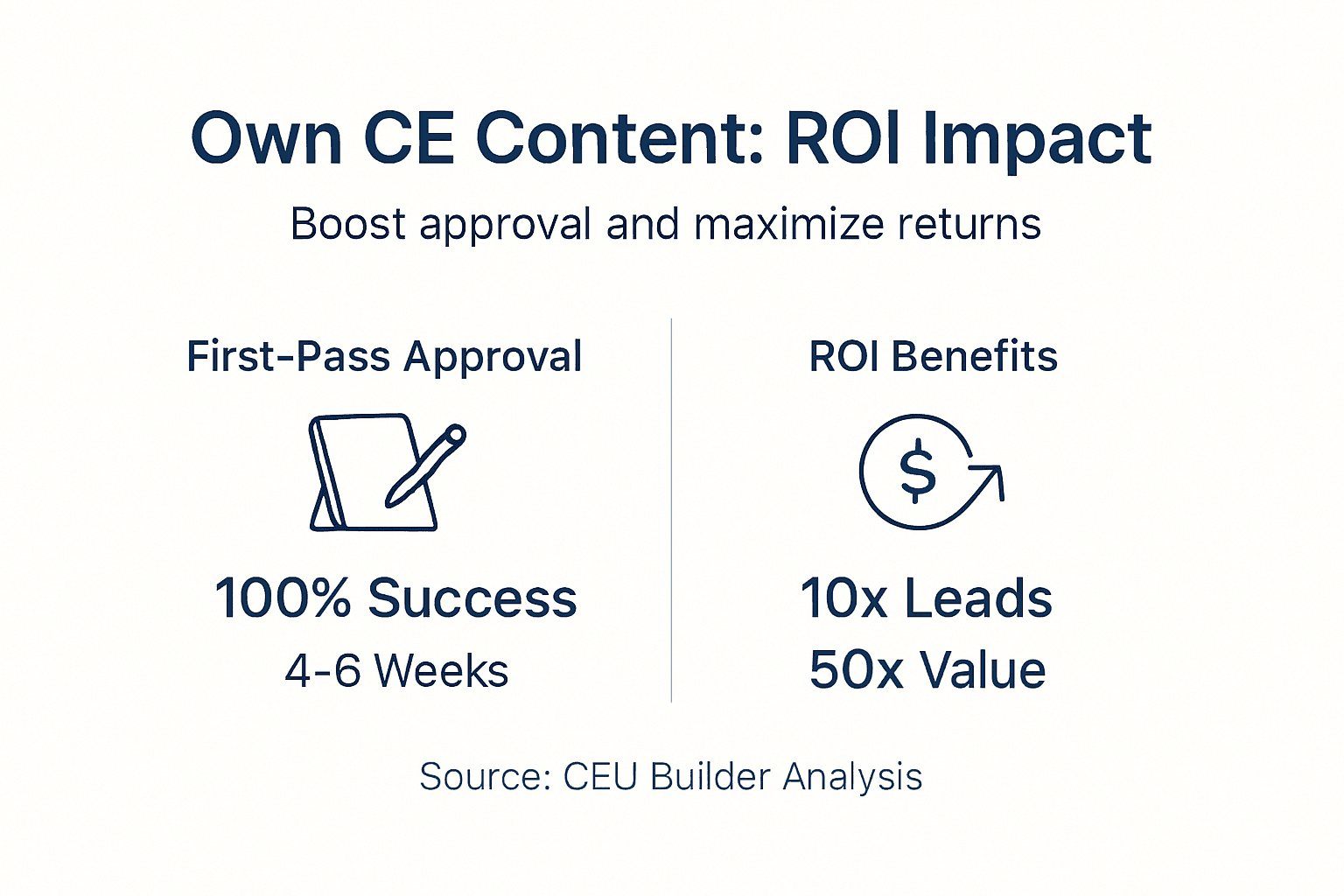
Owned CE courses engage architects for 45-60 minutes, leading to 2%+ conversion from completions to product specifications. In hospitality projects where product packages often exceed $100,000, a single specification returns 10x the course development investment.
The ROI math is straightforward. A $10,000 course generating 200 architect completions in year one creates 200 qualified touchpoints. At 2% conversion, that’s 4 specifications. With average project values around $125,000 in product selection, you generate $500,000 in attributed revenue from a $10,000 investment.
First-year ROI potential: 50x for manufacturers with strong specification close rates.
The economics improve over time because courses have indefinite shelf lives. Year two generates additional completions with zero development cost. Year three compounds further. The initial investment creates perpetual lead generation infrastructure, unlike trade show booths requiring annual renewal or advertising demanding continuous spend.
Ownership enables continuous refinement based on engagement data:
- Identify which course sections architects spend most time reviewing
- Track which topics correlate with highest specification conversion
- Optimize exam questions based on answer pattern analysis
- Adjust content emphasis based on completion rate metrics
This data-driven approach improves course effectiveness continuously. Generic providers lack incentive to optimize your specific courses because they serve multiple competing manufacturers. Your success isn’t their priority. When you own content, every improvement directly benefits your specification pipeline.
Offering CEU courses strategically positions your brand as educator before competitors reach architects with sales pitches. This timing advantage is critical in hospitality where specification decisions happen early in design phases, often 6 to 12 months before construction.
CEU course approval that happens in 4 to 6 weeks instead of 6 to 12 months means you capture market opportunities competitors miss entirely while stuck in development cycles.
Risks and Misconceptions About Outsourcing or Ignoring CE Content
The belief that outsourcing saves time and money collapses when you factor in failure rates and delays. Outsourced generic courses yield 30-50% lower completion rates because they fail to address what architects actually want to learn. Low completion means minimal business impact regardless of accreditation status.
Generic content lacks the strategic alignment that drives specifications. Providers create courses meeting IDCEC requirements but missing market needs. Architects complete them for credits but gain no preference for your products. You pay for accredited content that generates zero competitive advantage.
Ignoring CE content entirely cedes educational positioning to competitors. Architects seeking required credits choose courses from manufacturers who invested in education. Those brands become the reference point when specification decisions happen months later. Your absence from the educational landscape means invisibility when it matters most.
| Approach | First-Pass Approval | Time to Market | Completion Rate | Specification Impact |
|---|---|---|---|---|
| Owned Content (Specialized) | 100% | 4-6 weeks | 75-85% | High (2%+ conversion) |
| Outsourced Generic | 45-60% | 12-20 weeks | 30-50% | Minimal |
| Internal (No IDCEC Expertise) | 15-25% | 24-52 weeks | Unknown | None (if rejected) |
| No CE Program | N/A | N/A | N/A | Zero |
Inexperienced internal attempts cause 6-12 month delays and cost overruns exceeding $20,000. Marketing teams spend months developing content only to face rejection requiring complete rebuilds. The opportunity cost includes missed specifications and market share loss to competitors with functioning CE programs.
Common misconceptions:
- “Any accredited course generates leads” – False. Generic content gets ignored by busy architects.
- “Outsourcing is faster” – False. High failure rates cause longer delays than specialized development.
- “We can build courses internally” – Rarely true without IDCEC expertise and instructional design skills.
- “CE content doesn’t influence specifications” – False. Educational positioning drives preference formation.
Pro Tip: Calculate your true cost of outsourcing by including potential rejection cycles, revision rounds, and delayed market entry. The apparent savings disappear when you account for total timeline and business impact.
CEU compliance for hospitality manufacturers requires understanding both IDCEC rules and industry-specific content needs. Generic providers master neither.
Leveraging Ownership: Data, Sales Efficiency, and Competitive Moats
Owning content provides actionable completion metrics identifying high-potential leads. You see which architects completed which courses, revealing specific product interests and knowledge levels. This data transforms cold outreach into warm conversations starting from shared educational context.
Course completion data improves lead quality by 35%, accelerating sales cycles and specification preference. Sales teams prioritize architects who engaged deeply with relevant topics, increasing close rates and shortening pipeline duration.
Educational authority developed through proprietary CE content builds durable specification preference. Architects remember manufacturers who taught them valuable skills. When specification decisions arrive months later, that educational relationship influences product selection even when competitors offer similar features and pricing.
The competitive advantages compound over time:
- First-mover educational positioning in specific topics
- Data accumulation revealing market trends and architect interests
- Sales efficiency improvements as prospects arrive pre-educated
- Brand recall strengthened through extended engagement windows
Faster time to market with owned content offers agility competitors relying on generic providers cannot match. When regulations change or new products launch, you update courses in weeks. Generic providers take months to revise content, leaving you positioned as the current expert while they scramble to catch up.
Pro Tip: Integrate course completion data with your CRM to trigger personalized follow-up sequences. Architects who completed acoustic performance courses get different outreach than those who studied fire safety regulations.
Educational positioning reduces sales cycle time by establishing credibility before first contact. Sales conversations skip introductory education and move directly to project-specific application discussions. This efficiency means your team closes more deals with the same headcount.
The course approval process completed in 4 to 6 weeks enables rapid market response. When competitors announce new products, you counter with educational content positioning your solutions as superior before their sales teams finish training.
Practical Steps for Hospitality Manufacturers to Own or Commission CE Course Content
Implementing strategic CE content ownership starts with research. Identify what architects actually search for and need to learn. Analyze competitor course offerings to find gaps. Survey your sales team about common architect questions and specification challenges.
- Conduct detailed market research on architect learning needs, search behavior, and competitive gaps in 2 to 3 weeks.
- Define learning objectives that teach design principles favoring your products without promotional language, aligning with IDCEC taxonomies.
- Engage instructional designers experienced in hospitality and IDCEC accreditation to develop compliant content from the start.
- Develop speaker scripts and slide decks following strict IDCEC compliance guidelines, avoiding all promotional triggers.
- Create exam questions testing comprehension and application, not brand recall or product comparison.
- Compile academic bibliographies meeting IDCEC standards with proper citation formatting and source diversity.
- Submit to IDCEC through experienced providers managing the complex filing process and technical requirements.
- Implement tracking infrastructure capturing completion data, architect contact information, and engagement metrics.
- Integrate with sales workflows so course completions trigger appropriate follow-up sequences and CRM updates.
- Monitor and optimize based on completion rates, specification conversion, and architect feedback.
Plan a 4 to 6 week timeline with phased content reviews and expert quality control. Week one focuses on strategy and learning objectives. Week two builds content. Week three handles client review and revisions. Week four manages IDCEC submission and approval.
Pro Tip: Start with one strategically selected course topic that addresses a high-value architect need and differentiates your products clearly. Prove ROI before expanding to multi-course programs.
Getting IDCEC approval requires understanding reviewer expectations and building compliance into every development stage, not treating it as final checklist item.
The course approval workflow designed by specialists eliminates the guesswork causing most failures. Every decision from topic selection to exam question phrasing considers IDCEC requirements.
The step-by-step accreditation guide provides process overview, but execution requires instructional design expertise and hospitality industry knowledge most internal teams lack.
Consider engaging specialized providers who understand both IDCEC compliance and hospitality specification dynamics. Their expertise compresses timelines and eliminates failure risk entirely.
How CEU Builder Supports Your CE Content Ownership Goals
CEU Builder delivers IDCEC-accredited courses with 100% first-pass approval, eliminating the costly rejection cycles that plague generic providers and internal teams. Our specialized expertise in hospitality manufacturing and IDCEC requirements means your courses reach market in 4 to 6 weeks, not 6 to 12 months.
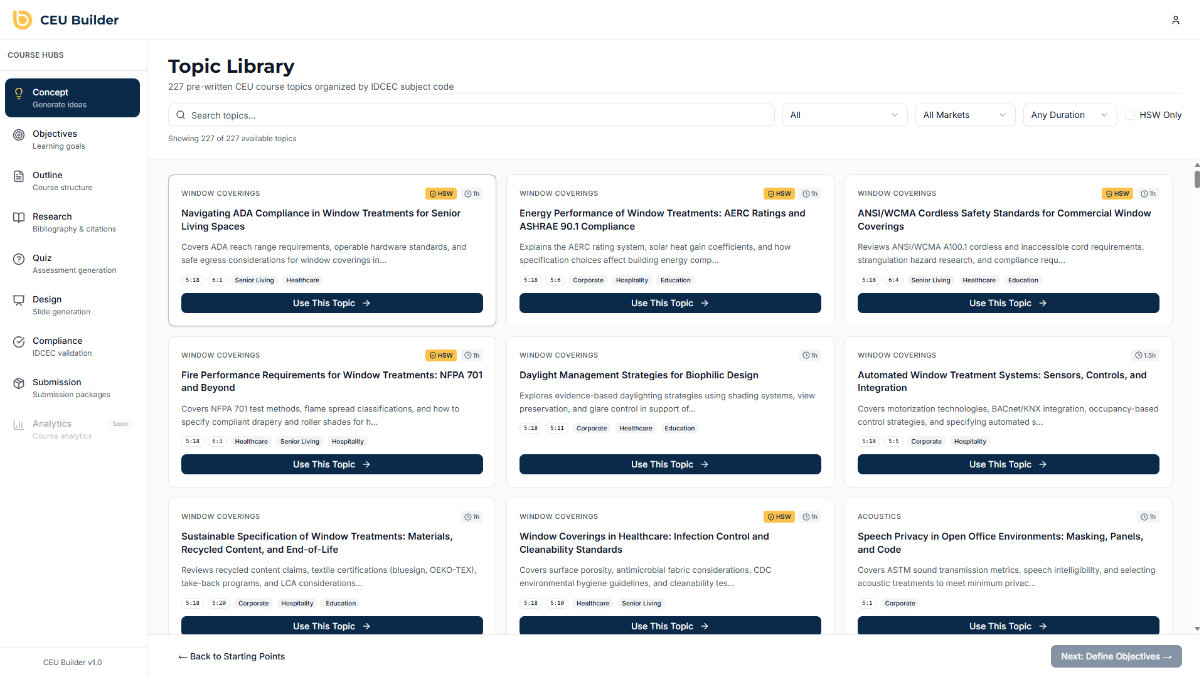
We handle complete course development from market research through final approval. You review content at key milestones but invest minimal internal resources. Our proven workflows compress traditional 90 to 180 day timelines by 80%, getting you to market while competitors remain stuck in development.
You gain actionable data showing which architects engage with which topics, enabling precision targeting and improved lead quality. Our platform tracks completions, issues certificates automatically, and integrates with your CRM for seamless sales follow-up.
The IDCEC approval process we’ve mastered ensures your investment generates business results, not accreditation headaches. Our accreditation guide reflects years of hospitality-specific experience no generalist can match. The course approval process we execute has never failed because we understand requirements thoroughly and build compliance into every stage.
Frequently Asked Questions
What is the typical timeline to develop and accredit an owned CE course?
With specialized providers, expect 4 to 6 weeks from kickoff to IDCEC approval. Week one covers strategy and learning objectives. Week two builds content including scripts, slides, and exams. Week three handles reviews and revisions. Week four manages submission and approval. Generic providers or internal teams often require 12 to 20 weeks or longer due to rejection cycles.
Can manufacturers update their CE courses post-accreditation to stay relevant?
Yes. Course updates addressing new regulations, product launches, or market trends are possible and recommended. Minor updates require IDCEC notification but not full reaccreditation. Major content overhauls may need resubmission. Owned content gives you flexibility to refresh courses in weeks when market conditions change, maintaining educational authority competitors cannot match.
How does owning CE content affect relationships with architects and designers?
Ownership positions you as educator rather than vendor, fundamentally changing relationship dynamics. Architects remember manufacturers who taught them valuable skills when specification decisions arrive months later. The 45 to 60 minute engagement window builds trust impossible through brief sales calls. Educational authority creates preference that persists across multiple projects over years.
What are the cost implications of owning versus outsourcing CE course development?
Specialized development costs $10,000 per course with 100% approval guarantee and 4 to 6 week timeline. Generic outsourcing appears cheaper initially but hidden costs include 40%+ failure rates, 6 to 12 month delays, and minimal business impact from irrelevant content. Total cost of outsourcing often exceeds $25,000 when accounting for rejections and lost specifications. Ownership delivers superior ROI through faster market entry and higher conversion rates.
How can completion data from CE courses be integrated into sales workflows?
Course platforms capture architect contact information and topic engagement at completion. Integrate this data with your CRM to trigger personalized follow-up sequences based on course topic and completion date. Sales teams prioritize leads showing specific product interest through course selection. Track which courses correlate with highest specification conversion to optimize topic strategy. Creating CEU courses with proper tracking infrastructure transforms educational content into measurable demand generation.
Recommended
